Court Building FAQ
The questions we get asked most, answered straight — including the ones where the honest answer is "it depends, and here is what it depends on."
How much space do I need for a pickleball court?
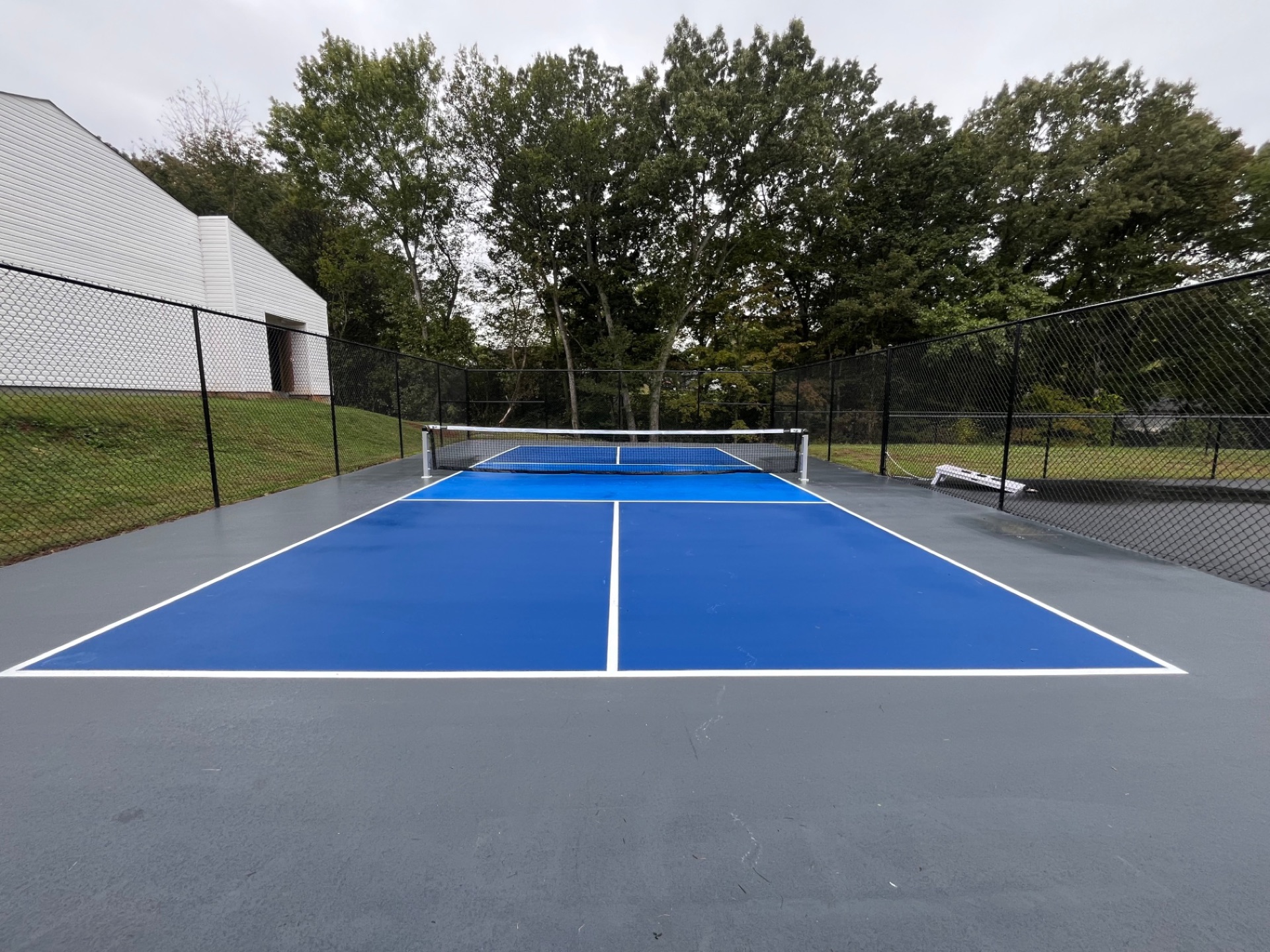
The playing surface is 20 by 44 feet, but that is not the number that matters. You need run-off space around it, so plan on about 30 by 60 feet as a practical minimum. We build 34 by 64 where the space allows, because the extra few feet behind each baseline is where most of the real game happens. If your yard is a little short, rotating the court diagonally fits more spaces than people expect.
Should I choose concrete or asphalt?
Concrete costs more up front and lasts longer with less attention. Asphalt costs less to install and is easier to resurface, but needs doing again sooner. Neither is a bad choice. In our experience the base material is rarely what ruins a court — bad base preparation, poor drainage and rushed curing are. A well-built asphalt court beats a poorly built concrete one every time.
What does a court cost?
It depends on the ground, access, drainage, grading, size and finish, and anyone who quotes you a firm price before seeing your site is guessing. What we can tell you is what drives the number: how much excavation and base work the ground needs, whether drainage has to be corrected, the surface system you choose, and extras like fencing and lighting. We will walk your space and send an itemised quote, free.
How long does it take to build?
A residential court is usually a matter of weeks rather than months, but the honest answer is that weather sets the pace. Concrete needs time to cure properly before surfacing, and rushing that is how you buy cracks. We give you a realistic schedule after the site visit and tell you which steps are weather-dependent.
Can you convert my old tennis court?
Often, yes, and it is usually far cheaper than starting over. A tennis court has plenty of room for one or more pickleball courts. If the existing slab is sound, it is a matter of repair, resurfacing and new striping. If the base has failed, we will tell you that instead of coating over a problem.
Does my court need resurfacing or rebuilding?
Faded colour, worn lines, lost texture and hairline cracks are surface problems, and resurfacing fixes them. Cracks you can fit a coin into, sections that have settled, and water that never drains are structural, and coating over them just hides them for a season. A quick test: an hour after rain, if water is gone and the surface is even, you are probably a resurfacing candidate.
Can I play other sports on the same court?
Yes. Multi-sport layouts are one of the most common things we build — pickleball with basketball, tennis lines, or both, using colour zoning so the lines stay readable. If you want a basketball goal or hybrid striping added to an existing court, that is a straightforward add-on.
Do you install fencing, lighting and nets?
Yes. Fencing, lighting, permanent net posts and hardware can all be part of the build. It is worth deciding early, because post sleeves and conduit are much easier to place before the slab goes in than after.
Do I need a permit?
It depends on your city or county, and sometimes on your HOA. Requirements vary across Tennessee, so we will tell you what applies where you are during the consultation rather than guess here.
How do I look after the court once it is finished?
Keep it clean and keep water moving off it. Sweep off leaves and debris, rinse it down periodically, and do not let organic matter sit and stain the surface. Address small cracks early — they are cheap to fix and expensive to ignore. Done properly, an acrylic surface will go years before it needs recoating.
Where do you work?
Across Tennessee, for homeowners, HOAs, clubs, community centres and commercial sites. If you are near the state line, ask — it is worth a conversation.
Still Have a Question?
Send us a photo of your space or your existing court and we will tell you what is realistic — no charge, no pressure.
Ask Us